

House Museums of Language – Slovenia and Ireland: Identity, Literature and Cultural Memory
Ryanair, Poets & House Museums: Taking Slovenia to Dublin
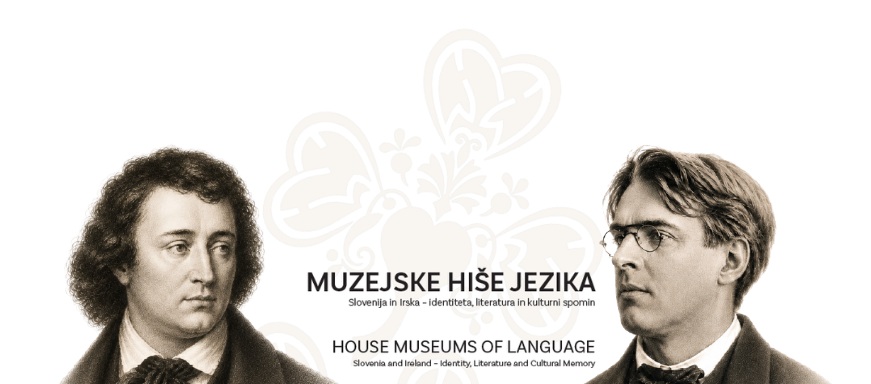
House Museums of Language was not going to be an ordinary exhibition trip to Dublin.
There are trips when you pack a few T-shirts, a toothbrush and perhaps a book you will never actually read.
And then there are trips when you board a Ryanair flight with a surprisingly large part of Slovenia’s literary heritage travelling with you.
France Prešeren. Matija Čop. Ivan Cankar. Alma M. Karlin. Simon Gregorčič.
Not literally, obviously. Ryanair’s baggage policy would probably have something to say about that.
But their stories, words, houses, photographs and memories were coming with us to Dublin. And, to be fair, I could hardly imagine better travelling companions.

So, why Dublin?
The mission was slightly unusual: to install and open our exhibition House Museums of Language – Slovenia and Ireland: Identity, Literature and Cultural Memory at the Embassy of the Republic of Slovenia in Dublin.
Yes. A house-museum nerd helping to put together an exhibition about house museums, literature and memory inside a beautiful historic building in Dublin.
I know.
This was going to be a good trip.
The exhibition was created by three doctoral students of heritage studies: Lucija Perko, Rok Humerca and me. Which basically means three heritage nerds were given the opportunity to spend a considerable amount of time thinking about old houses, dead writers, memory, poetry and objects.
What could possibly go wrong?
Rok is also the kind of person who will happily join me in visiting abandoned old houses before somebody demolishes them. He is an archaeologist, so technically he has an excuse.
Lucija does it too. She has no archaeological excuse. Neither do I.
Real heritage nerds.

Moving panels, cleaning vitrines and eating potica
Sure, an exhibition looks very elegant once it is finished.
Before that, we were mostly wondering what exactly we had got ourselves into.
Luckily, we were in very good hands. Ambassador Matej Marn and his wife Ajda were incredibly warm and generous hosts, and their enthusiasm for the whole project made the Embassy feel like exactly the right home for our exhibition.
And then there was the Embassy team. Together with Anna, Viktor, Sunčica and Tjaša, we carried panels, moved objects, cleaned display cases, arranged publications, checked details, moved things again because they looked better somewhere else, and slowly watched the exhibition take shape.
And there was potica.
Obviously.
You cannot bring Slovenian culture to Ireland and then forget the traditional cake.
Well, technically, you probably can.
But you shouldn’t.


But is it actually about house museums?
Yes.
And no.
We wanted to go a little further.
The idea was to create a dialogue between Slovenia and Ireland through house museums, literature, language, poetry and cultural memory.
What happens when you put France Prešeren next to W. B. Yeats?
Matija Čop next to Douglas Hyde?
Ivan Cankar next to Oscar Wilde?
Alma M. Karlin next to James Joyce?
Simon Gregorčič next to Francis Ledwidge?
These people did not live the same lives. Their countries did not share the same history. Their houses and places of memory are very different.
And that is precisely where things become interesting.
Literature and language played an extraordinary role in the development of national identity in both Slovenia and Ireland. Writers and poets became more than writers and poets. Their homes became places of memory. Their belongings became museum objects. Their words survived them.
And sometimes the original house does not survive at all.
So what exactly are we preserving?
A building?
A collection?
A biography?
An atmosphere?
Or simply the idea that something important happened here?
Now that is proper House Museum Nerd territory.

The houses behind the exhibition
One of the best parts of the whole project was working with people who actually look after these places.
The exhibition brought together stories connected with Prešeren’s Birth House, Čop’s Birth House, Cankar Memorial House, Alma M. Karlin Memorial House and Simon Gregorčič’s Birth House in Slovenia, and Thoor Ballylee, the Douglas Hyde Interpretative Centre, Oscar Wilde House, the James Joyce Centre and Francis Ledwidge Museum in Ireland.
Different houses. Different institutions. Different approaches to memory.
But the same fundamental question:
How do you keep a person’s story alive after they are gone?
We even invited poetry itself to join the conversation. Prešeren’s Kam? travelled between Slovenian, English and Irish, while Yeats’s The Lake Isle of Innisfree crossed the other way into Slovenian.
Words travelling between languages.
Which, when you think about it, is exactly what words are supposed to do.
And then 300 people arrived
You spend months working on an exhibition and eventually there comes that slightly terrifying moment when you have to stop changing things.
The doors open.
People come in.
And the exhibition no longer belongs only to you.
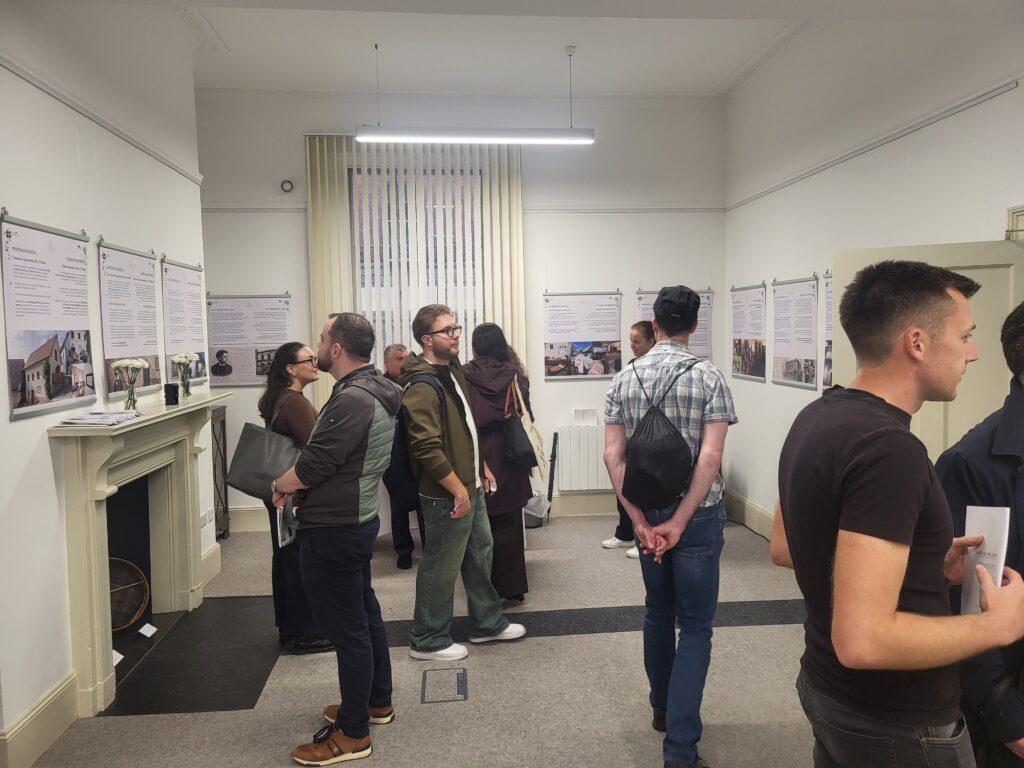
Around 300 visitors came to the opening.
Three hundred!
They walked between the panels, looked at the objects, read the poems, watched the films and discovered the connections between Ireland and Slovenia.
And judging by the conversations that evening, something worked.
I hope so, anyway.
Perhaps that is the best you can ask from an exhibition: not that everyone leaves with the same answer, but that they leave with another question.

We also received a wonderful video welcome from Timna Seligman, Chair of ICOM DEMHIST, bringing the wider international house-museum community into the evening.
And then there was music.
Here Is My Home
Before travelling to Dublin, Aleksander Mežek came to Čop’s Birth House in Žirovnica and recorded Here Is My Home, a song he had written for Ireland.
Think about that journey for a moment.
A song connected with Ireland.
Performed by a Slovenian musician.
Recorded inside a Slovenian house museum.
Then carried to Dublin and played at the opening of an exhibition about Slovenia, Ireland, houses, memory, literature and words travelling between cultures.
Sometimes heritage projects give you moments that are almost suspiciously perfect.
This was one of them.
And after the opening?
We were in Dublin.
Two heritage nerds – unfortunately, Lucija couldn’t make it to Dublin.
Of course we behaved responsibly.
We went to the pubs.
Guinness.
Jameson. Teeling. Bushmills. Tullamore Dew.
Research.
Very serious research.


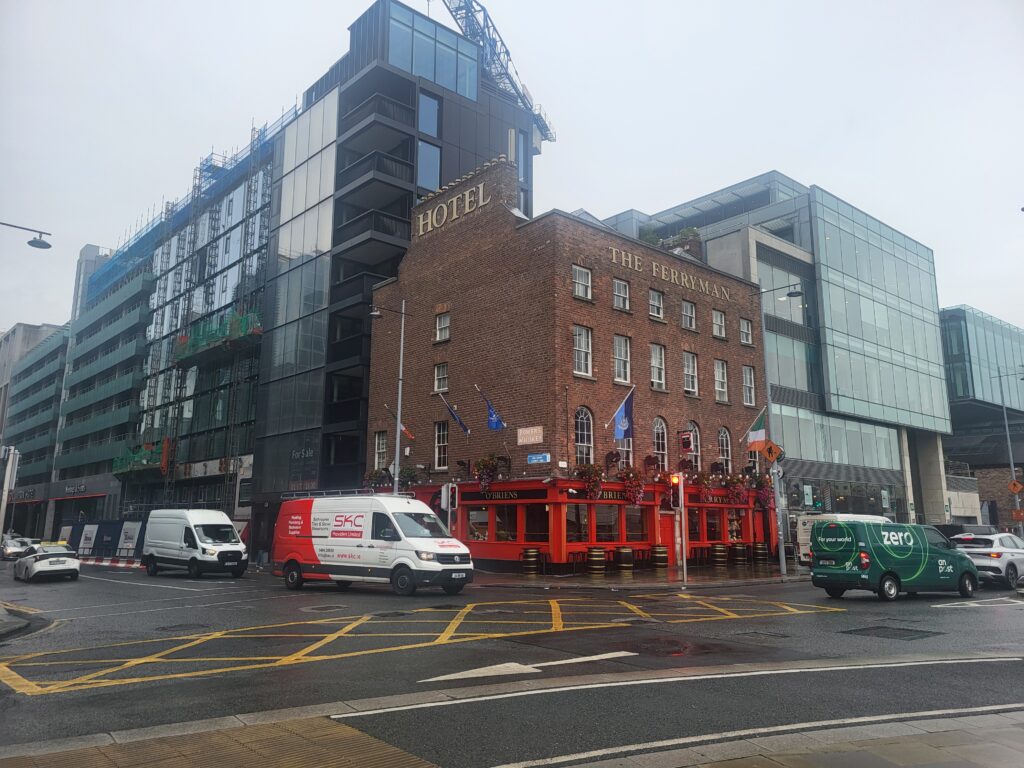

But Dublin is dangerous territory for a house-museum nerd because there is always another door you want to open.
And there were some excellent doors.
Oscar Wilde House
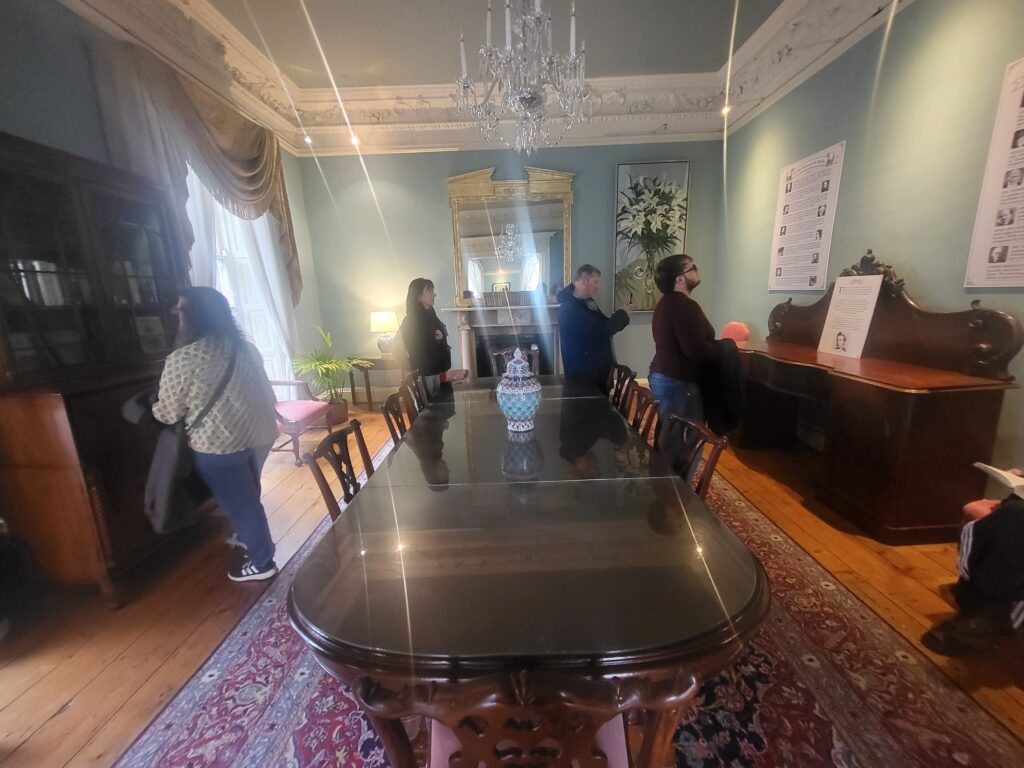
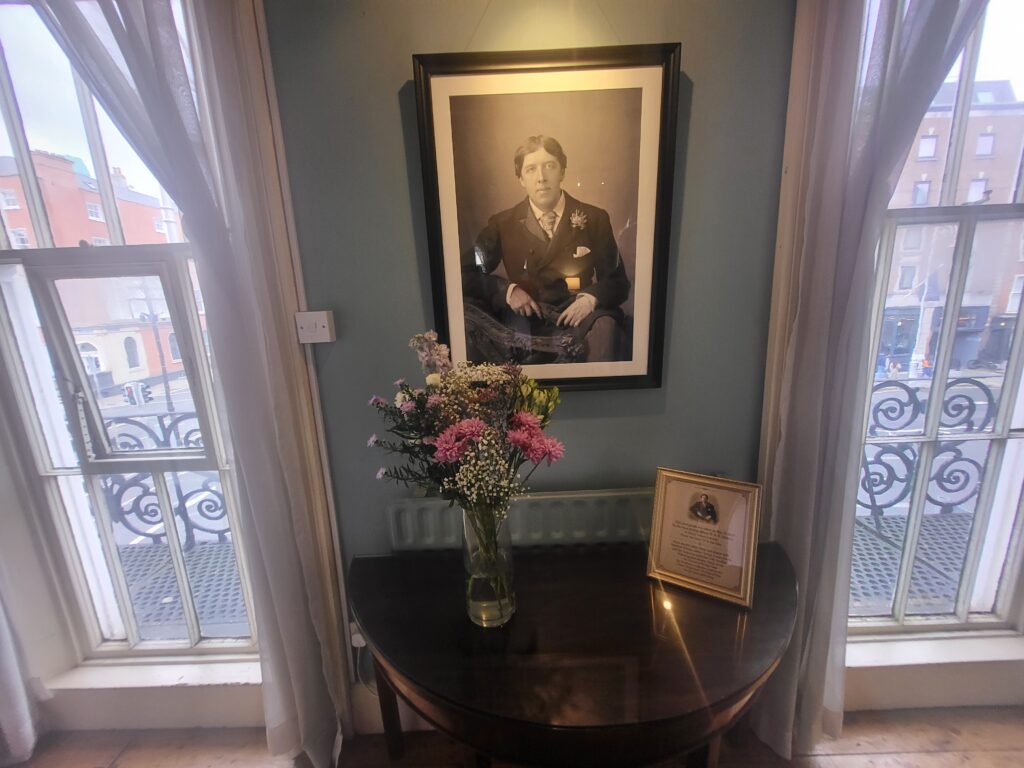
Oscar Wilde House was a highlight. Beautiful, atmospheric and brilliantly presented. One of those places where the building itself is already telling you something before anyone starts explaining it.
Especially the dining room. Wilde considered the evenings hosted there by his mother Jane an important part of his education. Writers, poets, artists and intellectuals gathered around the table – among them Bram Stoker, John B. Yeats, Samuel Ferguson and William Smith O’Brien – while young Oscar listened.
Not a bad classroom.
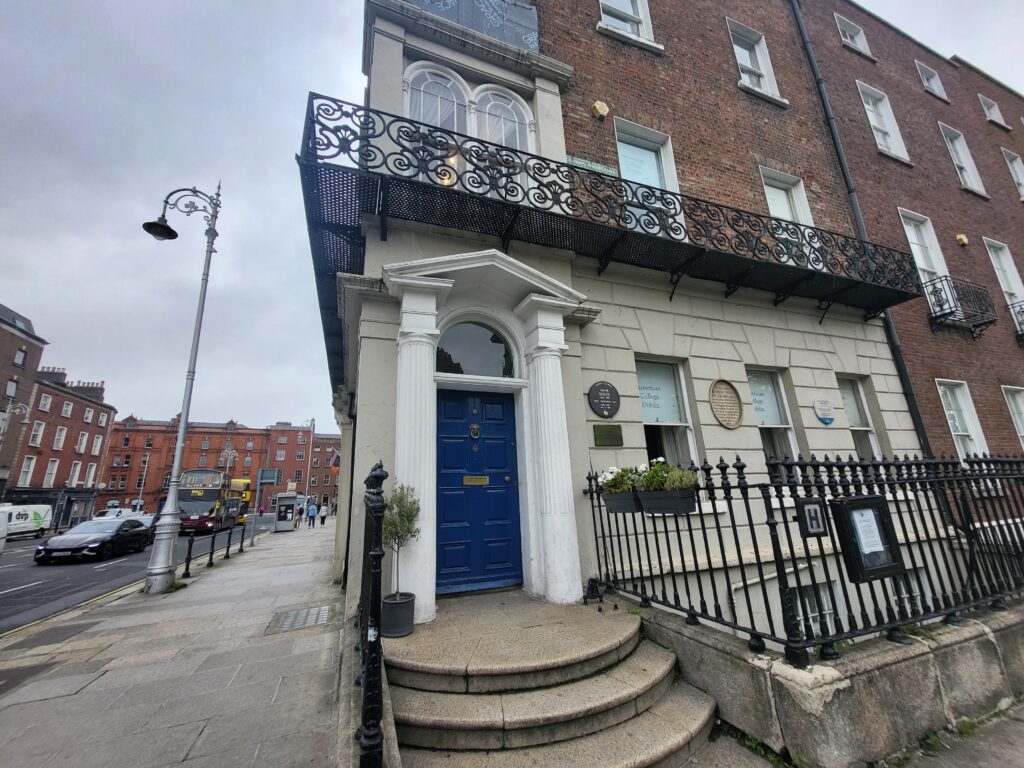



James Joyce Centre
Then came the James Joyce Centre, including a rather wonderful encounter with a door associated with Ulysses.
I was happy.
House Museum Nerd standards are sometimes surprisingly easy to meet.


Mummies, archaeology and other perfectly normal holiday activities
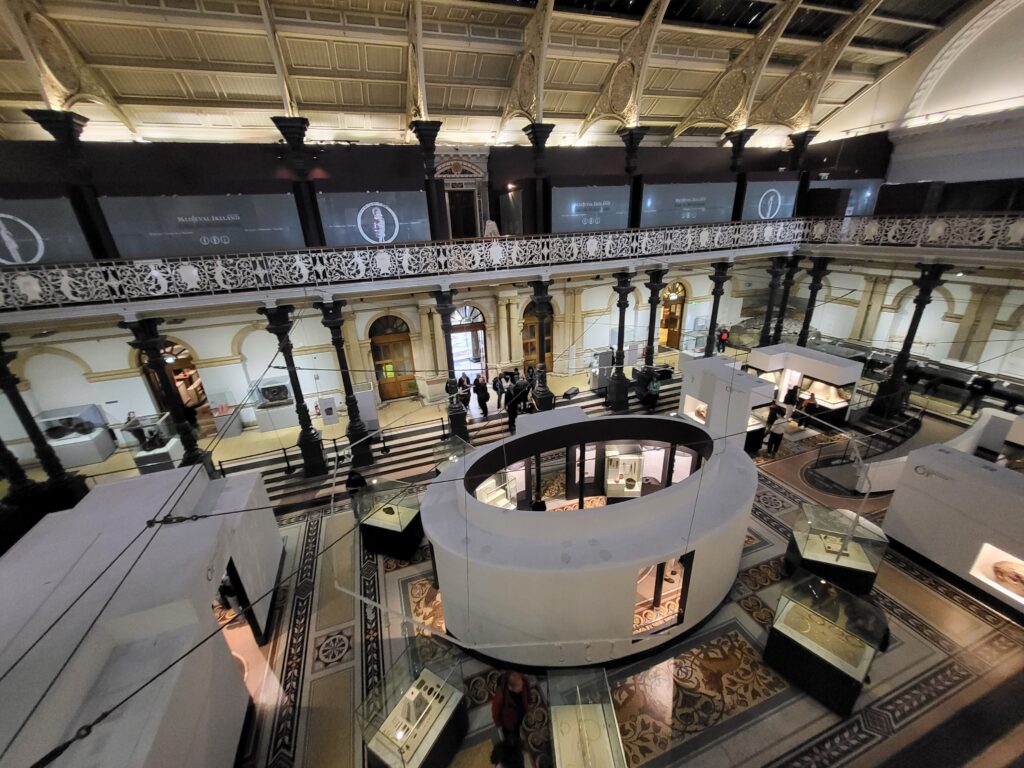
We also visited EPIC, National Museum of Ireland and National Library of Ireland.
And yes, there were archaeological collections.
And bog bodies.
Rok was delighted.
He even photographed one.
Please don’t judge him too harshly. Like I said, he is an archaeologist. This is what happens when archaeologists are allowed out unsupervised.
The fascinating thing about Dublin is how quickly you can move from literature to archaeology, from national history to music, and then somehow end up back in a pub.
Which is probably not a bad way to understand a city.



The Rolling Stones at Windmill Lane Studios
There was one more pilgrimage to make.
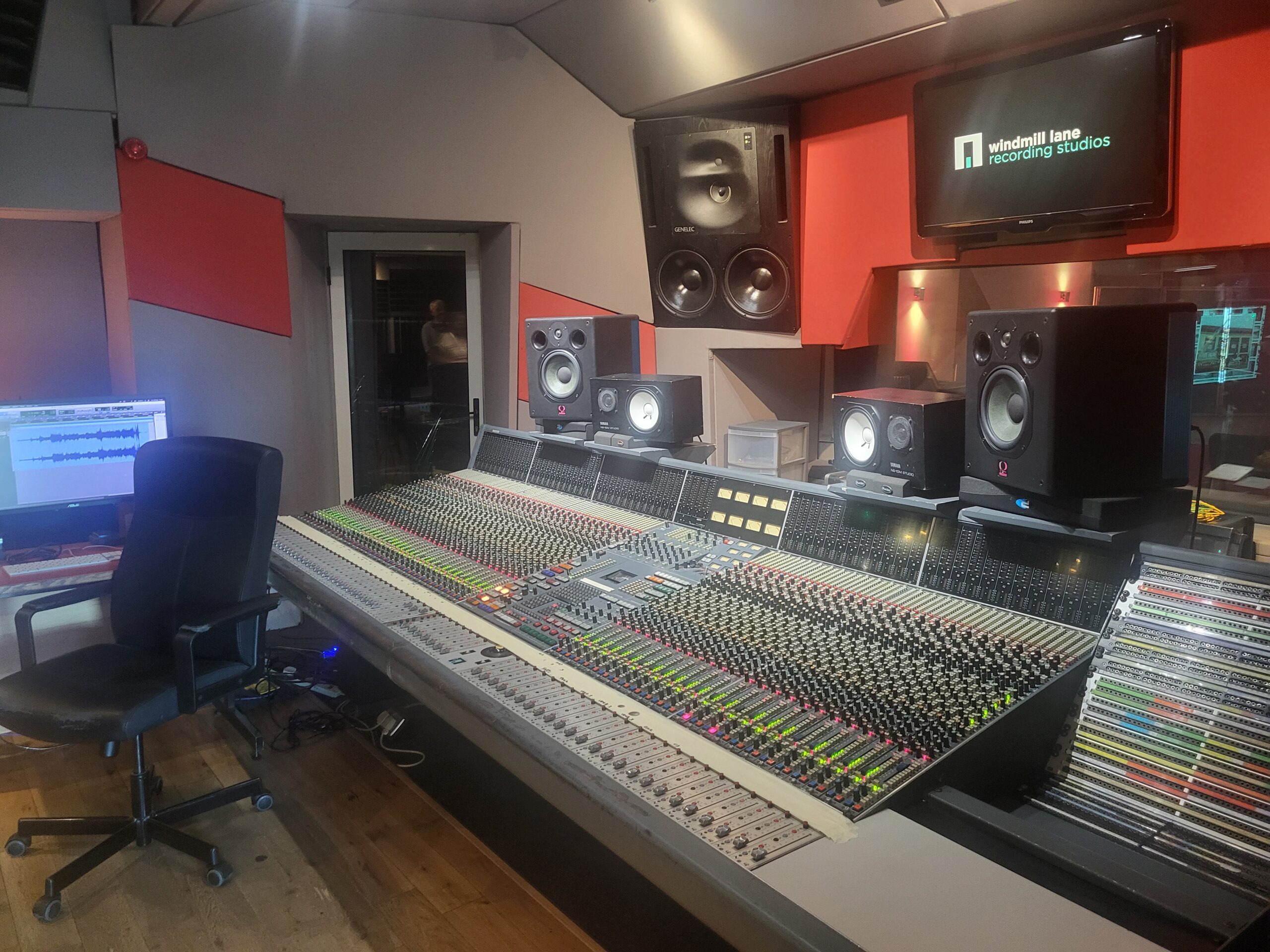
Windmill Lane.
Because apparently my definition of cultural heritage also includes recording studios.
And why shouldn’t it?
The Rolling Stones recorded at Windmill Lane during the making of Voodoo Lounge.
And they were hardly alone. U2, The Cranberries, Gorillaz, Marianne Faithfull, David Bowie – the list of ghosts in these rooms is rather impressive.
Now, I am perfectly capable of standing inside a writer’s former bedroom and getting excited about an old desk.
So obviously the thought of the Stones recording in Dublin also works for me.
Houses remember things.
Studios do too.
Cities definitely do.



Dubliners, you’re wonderful
What stays with me most from this trip?
The people.
The Irish really are incredibly warm.
From our colleagues and partners to the people we met in museums, pubs, cultural institutions and at the exhibition opening, there was a sense of genuine curiosity and welcome.
And perhaps that is ultimately what House Museums of Language was supposed to be about.
Not deciding that Prešeren is the Slovenian Yeats, or that Cankar is our Wilde.
That would be too easy.
It was about putting their stories next to each other and seeing what happens.
A Slovenian poem in Irish.
An Irish poem in Slovenian.
A traditional object from a Slovenian home sitting in Dublin.
A song travelling back to the country that inspired it.
A house speaking to another house.
And 300 people walking through the middle of it all.
Not bad for a few panels, some old objects and a group of heritage nerds who probably spend far too much time thinking about dead writers’ houses.
And apparently the journey might not be over yet.
There is a chance that the exhibition will travel further around Ireland.
If it does, I’ll let you know where our little travelling circus of poets, writers and house museums turns up next.
After all:
Houses have stories. Words travel.
Apparently, exhibitions do too.

More Information about House Museums of Language – Slovenia and Ireland: Identity, Literature and Cultural Memory
Official website: House Museums of Language – Slovenia and Ireland: Identity, Literature and Cultural Memory
Exhibition catalogue: Download PDF
Photos: Viktor Cibulka, Matjaž Koman / House Museum Nerd
Text: Matjaž Koman / House Museum Nerd
This post is part of the Ultimate House Museum Guide for Nerds – a personal project exploring the beauty, strangeness and magic of house museums around the world.