

Forgotten and Living Houses: Villa de Seppi & Rižnar’s House, Hrastnik, Slovenia
Villa de Seppi & Rižnar’s House
Sometimes puppets take me to places I didn’t plan to visit.
And sometimes, even in a small country like Slovenia, you realise how much you still don’t know.
A puppet show in Zagorje ob Savi.
Early morning. No coffee yet.
Wonderful audience.
That quiet joy of performing before the day fully wakes up.

After the show, my colleague and I do what puppeteers always do.
We look for coffee.
And accidentally, for heritage.
We drive toward Hrastnik.
On the right: a modern glass factory.
On the left: a small castle.
Beauty and the Beast.
Industry and elegance.
Wait.
Is that… Miramare?
In Slovenia?
“Do you mind if we stop for a minute?”
“Of course not.”

Villa de Seppi
Villa de Seppi is not a house museum.
It’s not open.
Not to the public.
Not to anyone.
Abandoned.
Quiet.
Slowly decaying.
How is this possible?
How can a historic house like this simply be left waiting?
No museum.
No residency.
No cultural centre.
Not even a private home for a millionaire.
Just silence.
Too decorated?
Too beautiful?
Too demanding for quick solutions?

Built at the end of the 19th century for the industrialist de Seppi family, the villa once spoke of confidence, progress, ambition.
Today, it speaks a different language.
Neglect.
And hope.
Named after Emma de Seppi, the woman who dreamed it into existence.
Built by Leonard Fantennutti.
Supervised by Anton Melan, an architect from Trieste.
And inside —
walls painted in calm, classical tones
by Eduard Lebiedzki, a Viennese painter
who knew how to make elegance feel permanent.
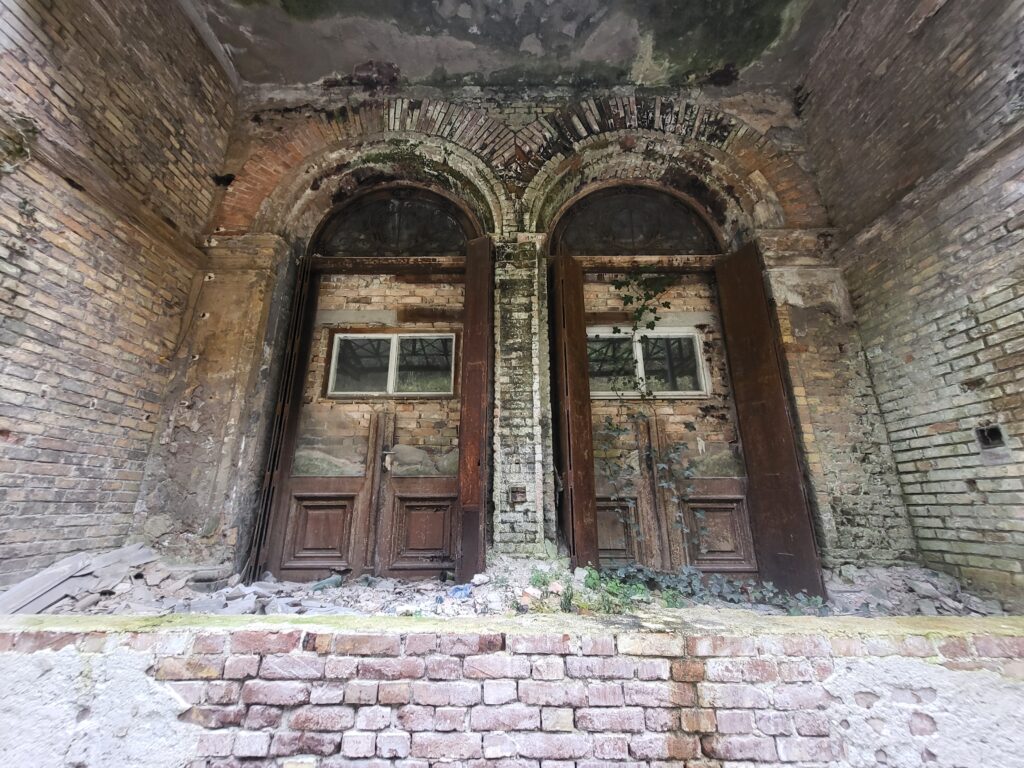
We walk around the ruins.
Peeling paint.
Fragments of ornament.
Traces of life.
I try a trick I first tested at the Pocar Homestead.
I press my phone against the glass.
And suddenly — the house opens.
A virtual visit.
Painted ceilings.
Ornamental walls.
A glimpse of former splendour.

Later I read that the municipality has finally bought the villa.
Renovation plans.
Good news.
Just one wish:
Please don’t over-renovate it.
Don’t erase all the scars.
They matter.

Rižnar’s House
We get back in the car.
Leave the beauty behind.
Still searching for coffee.
And then — another brown sign.
Those signs always mean something.
Rižnar’s House.
What is this, Christmas?
Two houses.
Without even looking for them.
This is a different story.
No villa.
No aristocracy.
Just a large, solid rural house by the river.

Built in 1790.
Once an inn.
A resting place for river workers.
They were called vlačugarji —
men who pulled boats upstream along the Sava River.
No aristocrats.
Hard-working people.
The house is a protected monument of local importance.
Still inhabited.
Officially, only exterior visits allowed.

We step closer.
A woman waves at us.
She invites us in.
She’s 92 years old.
She’s lived here since the 1960s.
And she’s genuinely happy we came.
Inside, nothing is staged.
No labels.
No vitrines.

Furniture from different decades.
Family photographs on the walls.
A stove newer than the ones used 300 years ago.
But the house…
The house is still here.
Floors.
Ceilings.
Walls.
History, breathing.
She shows us the black kitchen.
Huge.
The largest I’ve ever seen in a house like this.
Of course.
It used to be an inn.
Today, it’s storage.
A bit messy.
A bit dusty.
But untouched.
Black smoke on the ceiling.
The hearth.
The structure.
Perfectly preserved.

And suddenly, it’s clear.
This woman — once a worker in the Hrastnik Glass Factory —
is an incredible conservator.
Without a diploma.
Without a professional title.
She didn’t “restore” the house.
She lived with it.


Final thought
Villa de Seppi waits.
Rižnar’s House lives.
One is forgotten.
The other is alive.
And both tell us something important about heritage.
Sometimes preservation is about funding, projects, and plans.
And sometimes it’s about care, continuity, and respect.
No museum opening hours required.
Soundtrack: U2 – Ultraviolet (Light My Way)
Because sometimes heritage doesn’t shout.
Sometimes it waits.
Or quietly lives on.
And sometimes all you need
is to slow down,
search for that coffee,
take a wrong turn,
and let heritage — forgotten or lived in —
light your way.
More Information on Villa de Seppi & Rižnar’s House, Hrastnik, Slovenia
Official website: No official websites for these two beauties. Maybe that’s the best part — they’re meant for nerds, not tourists.
Photos: Matjaž Koman / House Museum Nerd
Text: Matjaž Koman / House Museum Nerd
This post is part of the Ultimate House Museum Guide for Nerds – a personal project exploring the beauty, strangeness and magic of house museums around the world.